
Lovable → Next.js
You already proved the idea in Lovable (or any vibe-coded demo). Motivd helps you graduate to a Next.js codebase on GitHub—PRD-first, multi-page scope, React and TypeScript, and a straight path to Vercel so you own the stack end to end.
Prototyping first is not a mistake—it is how most serious products start. You are allowed to outgrow the canvas.
Lovable is a fast way to sketch a product in the browser. When you are ready for SEO, custom infra, or a repo your team can review, Next.js on Vercel is the standard.
Motivd is built for that handoff: describe what you want, align on a Product Requirements Document, then generate and iterate on real Next.js code—not a black box.
You keep your narrative, your pages, and your deployment story. Connect GitHub when you want; build in Motivd Cloud until then.
Founders rarely stall on syntax alone. They stall on feelings: loss aversion, identity (‘am I technical enough?’), ambiguity fatigue, and the quiet shame of a demo that still lives inside someone else’s product. Motivd is designed to lower those emotional costs—not with hype, with structure you can point at.
Loss aversion whispers that migrating means admitting sunk cost. Flip the frame: screens, copy, and flows are durable knowledge. Motivd imports that knowledge into a PRD so you upgrade the delivery layer without erasing the idea. You are not ‘throwing away’ Lovable—you are promoting the concept to a real asset class: a repo.
Imposter feelings spike when folders appear. You do not need to parse every file. You need a decision surface you trust: an approved spec, visible pages, and permission to invite someone who loves diffs. Motivd keeps you in the founder chair—clarity first, implementation second.
Open-ended chat rewards novelty and punishes closure; your brain keeps generating ‘what if’ branches. Writing scope down exploits the Zeigarnik effect in reverse: finished mental loops. When the PRD is green-lit, your nervous system gets the same cue a PM gives a team: this is the version we build.
Many founders carry tension around ‘it only lives in the builder.’ A GitHub-backed Next.js app is an object others recognize—advisors, hires, investors. That recognition reduces isolation. You are not performing technicality; you are offering a legible artifact, which increases trust without you pretending to be someone you are not.
Founders searching Lovable to GitHub want a path out of a locked preview. Motivd generates a normal Next.js repo you can push to your organization, open pull requests on, and hand to contractors—the difference between a demo URL and software you can sell, audit, or insure.
When the question is how to deploy Lovable to Vercel or beat the SEO limits of a hosted builder canvas, the durable answer is usually Next.js. Motivd targets structured routes, server rendering where it counts, environment variables, preview deployments, and custom domains—the playbook serious SaaS teams use.
A real Lovable to Next.js migration should land in React and TypeScript with patterns your future team can read. Whether you started in Bolt, v0, Replit, or Cursor-assisted experiments, Motivd replaces guesswork with a PRD-backed codebase that behaves like a product, not a one-off prompt.
Modern builders let you pick routes, review scope, and press go. Below is an example of that kind of flow—structured page selection and a clear add-to-project action—so shipping feels intentional, not accidental.
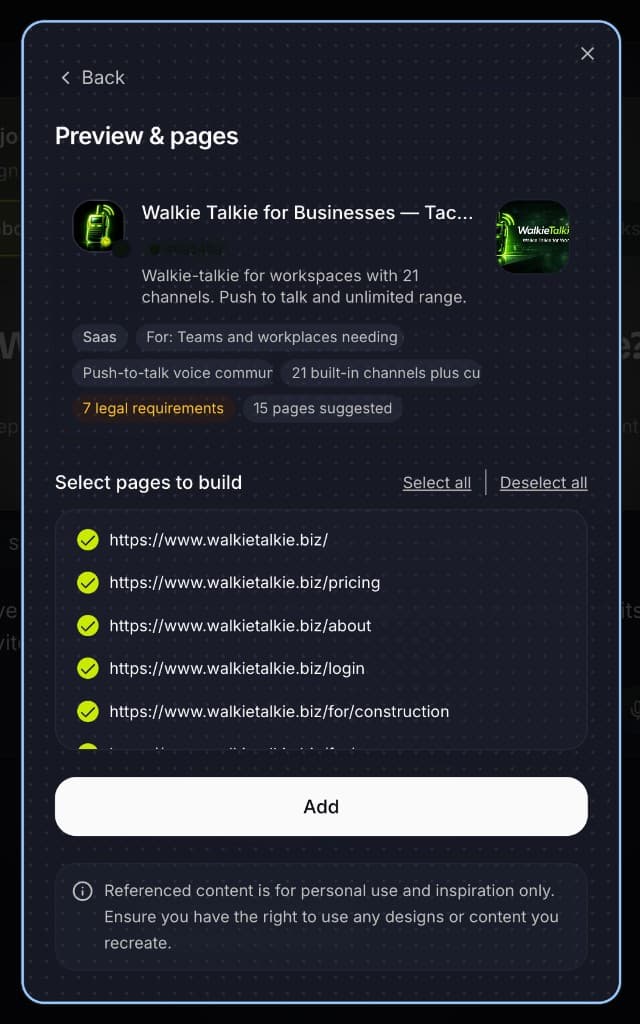
Referenced content is for personal use and inspiration only. Ensure you have the right to use any designs or content you recreate.
Approve scope in writing so your Next.js app matches the business—not just the first prompt.
Output matches how serious teams ship: components, routes, and deploy targets you recognize.
Your code lives in your org. No lock-in; push and hand off to engineers anytime.
Same hosting story as top Next.js products: previews, production, env vars, domains.
Think in pages, flows, and requirements—closer to how you will grow the product.
Describe features in plain language; Motivd handles spec, structure, and implementation details.
Paste your Lovable summary, link, or screenshots—or describe the app fresh. Context carries forward.
Review pages, flows, and requirements. Edit until the spec matches what you will ship.
Motivd builds in your workspace; connect a repo and deploy to Vercel when you are ready.
| Motivd → Next.js | Typical Lovable flow | |
|---|---|---|
| Planning artifact | Structured PRD you approve | Chat-first; easy to drift |
| Code destination | Your GitHub + Next.js repo | Hosted builder output |
| Page / route thinking | Explicit pages and flows | Often single-app focus |
| Deploy model | Vercel-native path | Platform-specific hosting |
| Team handoff | Engineers read familiar code | May need rebuild for standards |
Yes. Export or describe what Lovable built—routes, copy, and key flows—and Motivd can help you recreate and extend it as a Next.js project with a clear PRD. You are not stuck retyping everything; bring links, notes, or screenshots.
Not as a universal guarantee—AI builders change often. The reliable approach is to treat your Lovable work as product truth (UX, copy, flows) and regenerate a clean Next.js implementation under a PRD. Motivd is built exactly for that “graduate the prototype” moment.
Usually yes, when you gain proper routes, metadata control, performance budgets, and a deployment model search engines trust. Next.js on Vercel is a common pattern for ranked marketing sites and authenticated apps alike; Motivd aims at that class of output instead of a single embedded preview.
Bolt and v0 are strong at fast UI generation. Motivd adds a structured PRD gate before code, multi-page thinking, GitHub ownership, Motivd Cloud or Supabase backends, and a founder workflow tuned to “ship and grow” rather than only “first draft.” Compare pages on this site walk through tradeoffs in detail.
Yes. Motivd supports Supabase-backed projects and Motivd Cloud when you want managed auth, database, and storage. You are not forced into a single database story—pick what matches your compliance and hiring plans.
No. Founders use Motivd both for greenfield products and for graduating prototypes from other AI builders into a repo they control.
Yes. Motivd targets the same modern stack founders expect: Next.js, standard project layout, and guidance toward Vercel deployment and custom domains.
No. You can build in Motivd Cloud first and connect GitHub when you want production handoff or team review.
That is enough to start. Motivd can infer structure from visuals plus your notes, then tighten scope in the PRD before generating code—often faster than manually cloning every pixel-perfect detail in a new framework.
Yes. Because the output is standard Next.js with familiar tooling, external engineers can review, refactor, and extend without reverse-engineering a proprietary builder runtime.
No. You paid for speed to clarity—and you likely got it. Graduating is not a confession; it is sequencing. The expensive mistake is rebuilding blindly without a spec, not moving to a stack that matches your next milestone. Motivd preserves your product thinking in a PRD so the money you spent becomes reusable context.
You should not have to cosplay as an engineer. Your job is decisions: scope, copy, priorities, risk. Motivd’s PRD step exists so those decisions live in plain language first. The repo is there for transparency and handoff, not as a test of your identity. Invite technical help when you want; you still own the direction.
Chat moves fast but leaves memory inside the thread—your brain fills the gap with anxiety. A PRD externalizes memory: agreed pages, flows, and constraints you can re-read. That reduces ambiguity, which is most of what people label ‘technical fear.’ It is often cognitive load wearing a hoodie.
Start free. Approve the PRD when it feels right—then ship code you are proud to put your name on.
One workspace turns plain-language intent into a real product with PRD alignment, owned code, and one deploy path.